Breaking the “We’ve Always Done It This Way” Trap
In business, some of the biggest barriers to growth aren’t budgets, systems, or market conditions. More often, they stem from habits and processes that have been repeated for so long that no one stops to ask whether they still make sense.
There’s a well-known story often shared in leadership circles about a group of monkeys, a ladder, and a bunch of bananas. Over the years, the lesson behind the story has remained surprisingly relevant because it highlights a fundamental truth about human behavior, particularly inside organizations.
Five Key Takeaways
Outdated habits can quietly become barriers to growth.
Organizations often repeat systems without questioning their purpose.
Unexamined processes can slow innovation and productivity.
Fresh perspectives often reveal opportunities for improvement.
Partnering with an experienced virtual executive assistant can help uncover and streamline inefficient processes.
The Story
Imagine five monkeys placed in a room. In the center stands a ladder, and hanging at the top of that ladder is a tempting cluster of bananas. Naturally, one of the monkeys tries to climb up to get them. The moment the monkey begins climbing, researchers spray all five monkeys with ice-cold water. It doesn’t take long for the group to recognize the pattern. Every time a monkey attempts to climb the ladder, everyone gets sprayed.
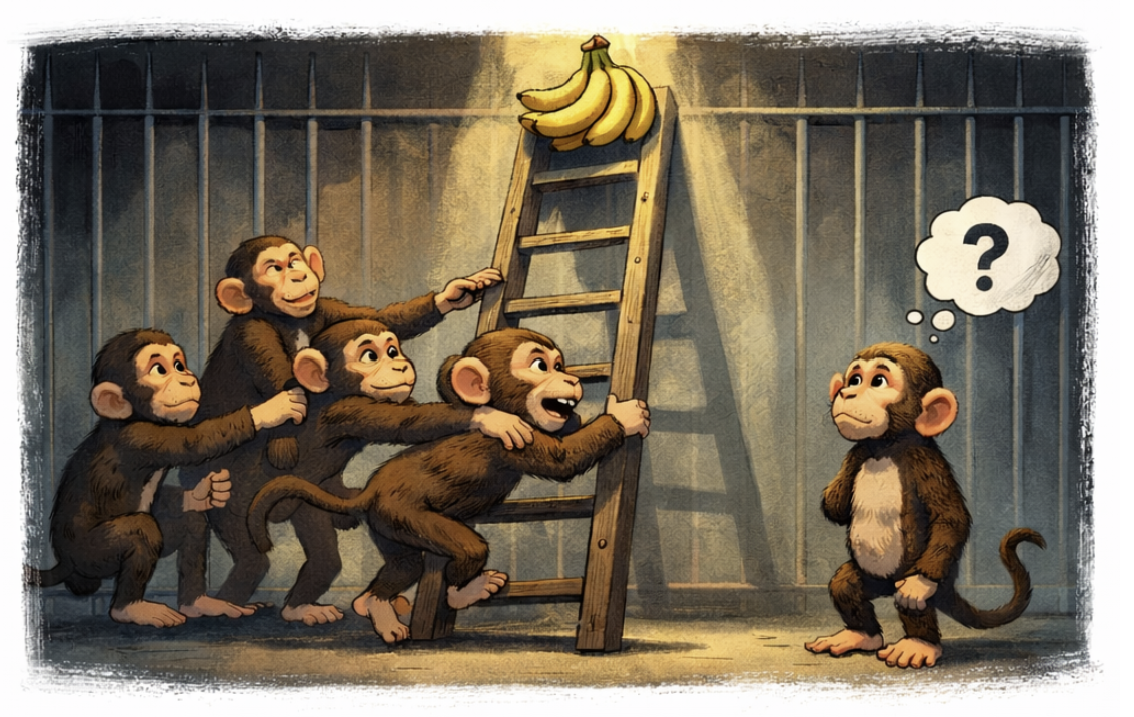
Before long, something interesting begins to happen. Whenever one monkey approaches the ladder, the others pull it down before it can climb. They’ve learned to prevent the problem before it starts. Eventually, none of the monkeys attempts to climb the ladder at all.
The Twist
Now, imagine that one of the original monkeys is removed and replaced with a new monkey. The new monkey immediately notices the bananas and heads straight for the ladder. But before it can climb, the other monkeys grab it and pull it down. The new monkey quickly learns an important rule: climbing the ladder is not allowed.
But here’s where the story becomes interesting. The cold-water spray is now turned off. One by one, the remaining original monkeys are replaced with new monkeys - monkeys who were never sprayed and never experienced the original consequence. Yet, every time a monkey approaches the ladder, the others still stop it. Eventually, the cage is filled with monkeys who have no idea why climbing the ladder is forbidden, but they enforce the rule anyway. If you could ask them why, the answer might be simple: "I’m not sure. That’s just how things are done here."
The Business Lesson
This story reflects something that happens inside organizations every single day. Processes are often created for good reasons, perhaps to solve a problem, reduce risk, or respond to a crisis. But as time passes, the original reason behind those processes often fades away. The rule, however, remains. New employees inherit procedures that nobody questions. Teams continue repeating workflows that may no longer serve the business. Entire systems keep running based on assumptions that stopped being true years ago. Eventually, people follow the process, not because it works, but simply because it exists.
The Cost of Unquestioned Systems
When organizations stop examining the why behind their systems, the consequences start to appear quietly:
Innovation slows
Efficiency begins to decline
Employees grow frustrated with unnecessary complexity
Leadership spends time managing outdated processes instead of improving them
In many cases, businesses don’t even realize how many “ladders” they’ve stopped climbing.
The Power of Fresh Perspective
This is one reason outside support can be incredibly valuable. Whether it’s a consultant, an operational partner, or an experienced administrative professional, someone stepping into a business from the outside brings something powerful: perspective. They don’t inherit the same assumptions. They notice the extra steps others have stopped seeing. They ask questions that haven’t been asked in years. And often, the most meaningful improvement begins with a very simple question: “Why do we do it this way?” More often than not, the answer reveals an opportunity to do something better.
Moving Forward
Healthy organizations don’t just build systems; they revisit them. They evaluate processes not out of habit or compliance, but because effectiveness matters. The goal of a business isn’t to preserve outdated routines. It’s to keep climbing the ladder.
If your organization feels stuck doing things the same way simply because “that’s how it’s always been done,” it may be time for a fresh perspective. Real progress often begins when leaders step back, challenge familiar processes, and take the first intentional step up the ladder again.